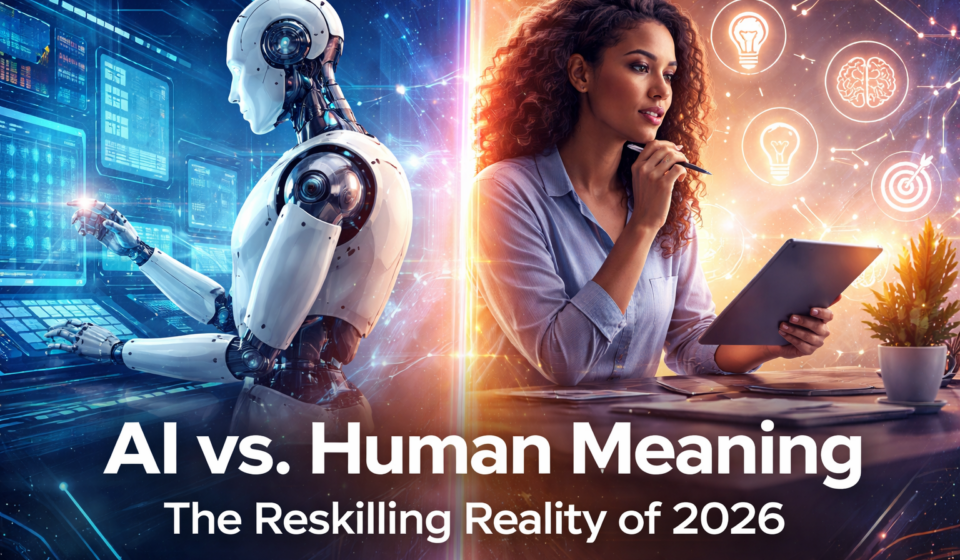
AI vs. Human Meaning: The Reskilling Reality of 2026
Introduction
In 2026, a quiet but profound shift has taken hold across the global workforce. A product manager in Bengaluru no longer writes code to automate workflows—she simply describes her goal in plain English. Within seconds, an AI system executes it flawlessly. This is no longer experimental. It’s the new normal.
As AI pioneer Andrej Karpathy famously observed, “The hottest new programming language is English.” That prediction has matured into reality. The reskilling reality of 2026 is not about learning more technical syntax—it’s about learning how to think, articulate, and decide with precision.
This is the defining shift of AI reskilling 2026: machines now dominate procedural execution, while humans are valued for meaning-making. The dividing line is no longer between technical and non-technical roles—it’s between those who can define what should be done and those who rely on knowing how to do it.
In this new landscape, the future of work reskilling is not about competing with AI—but about becoming irreplaceably human.
The End of Syntax: Why English Is the New Programming Language
The most radical transformation in AI reskilling 2026 is the collapse of traditional programming barriers.
From Code to Clarity
For decades, technical fluency meant mastering programming languages like Python or Java. In 2026, natural language programming AI has changed that paradigm entirely.
Today’s systems can:
- Translate plain English instructions into production-grade code
- Execute multi-step workflows from conversational prompts
- Debug, optimize, and deploy without human intervention
This shift has made English the new programming language, but with a critical caveat: clarity beats complexity.
The Rise of Prompt Engineering 2026
“Prompt engineering” has evolved into a core workplace skill. But it’s no longer about clever phrasing—it’s about structured thinking.
Key capabilities include:
- Defining precise goals and constraints
- Structuring multi-step reasoning
- Anticipating edge cases and outcomes
In essence, prompt engineering 2026 is less about talking to machines—and more about thinking clearly enough to guide them.
What This Means for Workers
The implications for the reskilling reality of 2026 are profound:
- Technical barriers are lower than ever
- Communication skills are now technical skills
- Ambiguity is the new inefficiency
Those who can articulate intent clearly now outperform those who merely execute tasks.
Procedural Memory to Machines: The Great AI-Human Divide
A defining concept in AI vs human meaning is the transfer of “procedural memory” to machines.
What Is Procedural Memory AI?
Procedural memory refers to the ability to perform routine, repeatable tasks:
- Data entry
- Report generation
- Coding implementation
- Process execution
In 2026, procedural memory AI systems handle these tasks with near-perfect consistency.
The New Division of Labor
This creates a clean divide:
Machines now dominate:
- Execution
- Optimization
- Repetition
- Speed-driven tasks
Humans now dominate:
- Judgment
- Context interpretation
- Ethical reasoning
- Strategic direction
The Strategic Shift
The workforce is no longer divided by job titles—but by cognitive roles:
- Executors (declining value)
- Orchestrators (rising value)
This is the core of the reskilling reality of 2026: value has moved upstream—from doing to deciding.
Human Superpowers That AI Cannot Replicate: Critical Thinking & Meaning-Making
As machines take over execution, human value consolidates around meaning.
Critical Thinking in AI Era
AI can generate answers—but it cannot determine which questions matter most.
In 2026, critical thinking in AI era includes:
- Evaluating AI-generated outputs
- Identifying biases and blind spots
- Making trade-offs under uncertainty
Workers are no longer judged by how much they know—but by how well they think.
Human Meaning-Making AI
AI processes information. Humans assign meaning.
This includes:
- Understanding cultural context
- Interpreting emotional nuance
- Defining purpose and direction
Human meaning-making AI is what transforms raw data into strategy.
Creativity as a Strategic Skill
Contrary to early fears, AI has not replaced creativity—it has amplified its importance.
Humans now focus on:
- Original idea generation
- Narrative framing
- Cross-domain synthesis
The New Skill Stack
The most valuable skills in AI reskilling 2026 are:
- Analytical thinking
- Creative problem-solving
- Communication clarity
- Ethical judgment
- Systems thinking
These are not “soft skills.” They are the new hard skills.
Hard Data from 2026: What the Reports Actually Say
The reskilling reality of 2026 is not speculative—it’s backed by data from leading global institutions.
World Economic Forum (Future of Jobs Report 2025)
According to the World Economic Forum (2025):
- 22% of jobs will be disrupted by 2030
- 170 million new roles will be created, while 92 million will be displaced
- 39% of core workforce skills will change by 2030
Top rising skills include:
- Analytical thinking
- Creative thinking
- AI and big data literacy
McKinsey (Superagency in the Workplace, 2025–2026)
McKinsey reports (2025–2026):
- AI could automate up to 30% of work activities by 2030
- Workers using AI tools are up to 40% more productive
- Organizations are shifting toward “superagency” models—where humans direct AI systems
Gartner AI Predictions 2026
Gartner (2026) highlights:
- By 2026, 80% of enterprises will use generative AI APIs or models
- Natural language interfaces will replace traditional software interfaces in many workflows
What This Data Really Means
Across all reports, one pattern is clear:
- Execution is being automated
- Decision-making is being elevated
- Reskilling is no longer optional—it’s continuous
This is the measurable foundation of AI reskilling 2026.
Real-World Reskilling Success Stories
The shift is already happening across industries.
1. Financial Services: AI-Augmented Analysts
Major banks in 2025–2026 have:
- Replaced manual reporting with AI systems
- Reskilled analysts to focus on scenario planning and risk interpretation
Result:
- Faster insights
- Higher strategic impact per employee
2. Healthcare: Doctors as Decision Orchestrators
Healthcare systems now use AI for:
- Diagnostics support
- Medical documentation
- Treatment recommendations
Doctors are being reskilled to:
- Interpret AI outputs
- Make final judgment calls
- Communicate complex decisions to patients
3. Marketing: From Execution to Strategy
Marketing teams have shifted from:
- Campaign execution → AI-driven automation
To:
- Brand storytelling
- Audience psychology
- Strategic positioning
This reflects the broader future of work reskilling trend: humans move up the value chain.
Your 2026 Reskilling Action Plan
Adapting to the reskilling reality of 2026 requires intentional effort.
Step 1: Master Goal Articulation
- Practice writing clear, structured instructions
- Break complex problems into steps
- Focus on outcomes, not tasks
Step 2: Build AI Fluency
- Learn how AI systems interpret prompts
- Experiment with different prompting styles
- Understand limitations and biases
Step 3: Strengthen Critical Thinking
- প্রশ্ন assumptions (yes, even AI outputs)
- Compare multiple perspectives
- Develop independent judgment
Step 4: Develop Meaning-Making Skills
- Study human behavior and psychology
- Improve storytelling and communication
- Focus on context, not just content
Step 5: Shift Your Identity
Move from:
- “I execute tasks”
To:
- “I define problems and guide solutions”
Step 6: Practice Daily
- Use AI tools actively
- Reflect on outputs
- Continuously refine your thinking
Conclusion
The AI vs human meaning debate is no longer theoretical—it is shaping careers in real time.
The reskilling reality of 2026 is not about competing with machines on speed or efficiency. That battle is already decided. Instead, it’s about redefining what it means to be valuable in a world where execution is abundant but meaning is scarce.
AI has not diminished human importance—it has clarified it.
Your ability to think critically, articulate clearly, and assign meaning is now your greatest professional asset. In this new era, the most powerful individuals are not those who know the most—but those who can define what matters most.
The opportunity is enormous—but so is the responsibility.
Because in 2026, the future doesn’t belong to those who can code.
It belongs to those who can think.