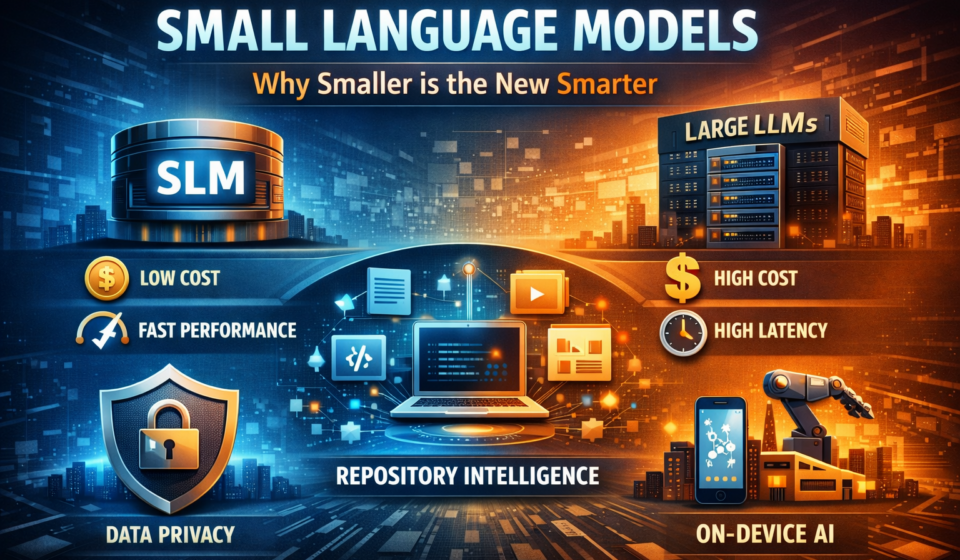
Small Language Models (SLMs): Why “Smaller” is the New “Smarter”
Introduction
For years, the AI industry operated under a simple assumption: bigger models are better models. From GPT-scale systems to trillion-parameter experiments, progress was measured in sheer size. But in 2026, that narrative is collapsing under its own weight.
Massive Large Language Models (LLMs) are running into hard limits—skyrocketing compute costs, unsustainable energy demands, high latency, and increasing impracticality for real-world deployment. Enterprises are no longer asking, “How big can we go?” but instead, “How efficiently can we solve real problems?”
Enter Small Language Models (SLMs)—compact, specialized, and surprisingly powerful systems that are redefining what “smart” actually means. Instead of brute-force generalization, SLMs excel through precision, context-awareness, and deployment flexibility.
But the real breakthrough isn’t just size—it’s repository intelligence. SLMs are uniquely positioned to deeply understand local data: your codebase, documents, internal systems, and historical decisions. This capability is rapidly becoming the defining feature of next-generation AI.
The thesis is clear: Smaller models are not just cheaper—they are smarter, more secure, and fundamentally better suited for enterprise and on-device AI in 2026.
Why Massive LLMs Have Hit the Wall
The limitations of massive LLMs are no longer theoretical—they are operational realities.
1. Exploding Compute and Cost
Training frontier models now costs hundreds of millions of dollars. According to multiple 2025–2026 industry disclosures:
- Training a top-tier LLM can exceed $100–300 million
- Inference costs remain high due to GPU dependency (especially NVIDIA H100/H200 clusters)
- Serving costs scale linearly with usage, making widespread enterprise deployment expensive
Even optimized APIs struggle with cost predictability at scale.
2. Energy Consumption and Environmental Impact
NVIDIA Research (2025) highlighted that large-scale LLM training runs can consume tens of gigawatt-hours, comparable to small cities. Inference at scale adds continuous energy drain.
Key concerns include:
- Carbon footprint of large model training
- Data center cooling and energy overhead
- Regulatory pressure in regions enforcing sustainability targets
3. Latency and User Experience
Large models introduce unavoidable latency:
- API round trips
- Token-by-token generation delays
- Network bottlenecks
For real-time applications—like copilots, embedded systems, or industrial automation—this latency is unacceptable.
4. Diminishing Returns
Scaling laws are flattening. Doubling parameters no longer yields proportional gains.
Recent benchmark analyses show:
- Marginal improvements in reasoning benchmarks
- Plateauing performance in domain-specific tasks
- Increasing hallucination complexity despite scale
5. Scalability and Deployment Constraints
Massive LLMs are difficult to deploy:
- Require cloud infrastructure
- Limited offline capability
- High dependency on centralized providers
For enterprises concerned with data sovereignty and control, this is a major blocker.
Bottom line: The “bigger is better” paradigm has reached its economic and technical limits.
The Rise of Small Language Models: Smaller Really Is Smarter
Small Language Models (SLMs) typically range from 1 billion to ~30 billion parameters, though some extend slightly beyond. What they lack in size, they make up for in efficiency and specialization.
What Makes SLMs Different?
SLMs are designed with:
- Efficient architectures (e.g., mixture-of-experts, sparse attention)
- Domain-specific fine-tuning
- Optimized inference for CPUs, edge GPUs, and mobile devices
They are not “mini LLMs”—they are purpose-built systems.
SLM vs LLM: A Practical Comparison
Size & Infrastructure
- SLMs: 1B–30B parameters, can run locally or on-device
- LLMs: 100B+ parameters, require large-scale cloud infrastructure
Cost
- SLMs: Up to 90% lower inference cost
- LLMs: High per-token cost, expensive scaling
Speed
- SLMs: Low-latency, near real-time
- LLMs: Slower due to model size and network calls
Specialization
- SLMs: Fine-tuned for specific domains (code, legal, medical)
- LLMs: Broad but often shallow generalization
Accuracy (Focused Tasks)
- SLMs: Often outperform LLMs in narrow domains
- LLMs: Strong general knowledge, weaker contextual depth
Why “Smarter” Matters
In 2026, intelligence is no longer defined by general knowledge—it’s defined by relevance. SLMs win because they:
- Understand specific contexts better
- Deliver faster, cheaper results
- Integrate directly into workflows
SLM vs LLM: Performance, Cost, and Practicality Comparison
| Feature | Small Language Models (SLMs) | Large Language Models (LLMs) |
|---|---|---|
| Parameter Size | 1B – 30B | 100B – 1T+ |
| Infrastructure Needs | Runs on CPU, edge GPU, or on-device | Requires large GPU clusters (cloud-based) |
| Inference Cost | Up to 90% lower | High per-token cost |
| Latency | Low (milliseconds to seconds) | Higher (API + compute delays) |
| Deployment | On-device, on-premise, edge AI | Primarily cloud-based |
| Privacy & Security | High (no data leaves system) | Lower (data sent to external APIs) |
| Data Sovereignty | Fully controlled | Limited control |
| Customization | Easy fine-tuning on local data | Expensive and complex |
| Repository Intelligence | Deep (understands local context & history) | Limited (generic knowledge + RAG) |
| Accuracy (Specific Tasks) | High (domain-optimized) | Moderate (broad but less focused) |
| General Knowledge | Moderate | Very high |
| Energy Consumption | Low | Very high |
| Scalability | Easy horizontal scaling | Expensive vertical scaling |
| Use Cases | Enterprise AI, on-device AI, edge systems | General-purpose AI, research |
Enterprise Security and On-Device Privacy: Where SLMs Dominate
One of the most compelling advantages of SLMs is their alignment with enterprise AI security and privacy requirements.
1. Data Sovereignty and Compliance
Enterprises must comply with regulations like GDPR, HIPAA, and regional data laws. Cloud-based LLMs introduce risk:
- Data leaves the organization
- Limited visibility into processing
- Potential exposure through logging or training pipelines
SLMs solve this by enabling:
- On-premise SLM deployment
- Full control over data pipelines
- Auditability and compliance alignment
2. Zero Data Exfiltration
With local AI models:
- Sensitive data never leaves internal systems
- No API calls to external providers
- Reduced attack surface
This is critical for industries like finance, healthcare, and defense.
3. On-Device AI and Edge AI
SLMs are optimized for edge environments:
- Smartphones
- Industrial IoT devices
- Autonomous systems
Benefits include:
- Real-time processing without internet
- Reduced bandwidth usage
- Enhanced privacy
4. Enterprise Adoption Trends
By early 2026:
- Over 60% of large enterprises are piloting or deploying local AI models
- On-device AI is a priority in sectors like automotive and manufacturing
- Hybrid architectures (SLM + selective LLM fallback) are becoming standard
5. Cost-Efficient AI at Scale
SLMs enable:
- Predictable infrastructure costs
- Reduced reliance on expensive GPUs
- Scalable deployments across thousands of endpoints
Key takeaway: Privacy-focused AI is no longer optional—and SLMs are the only practical way to achieve it at scale.
Repository Intelligence: The Killer Feature of SLMs
If SLMs are the future of AI, repository intelligence is the reason why.
What Is Repository Intelligence?
Repository intelligence refers to an AI system’s ability to deeply understand:
- Codebases and their structure
- Document ecosystems
- Historical decisions and changes
- Dependencies and relationships
- The intent behind actions—not just the output
This goes far beyond traditional LLM capabilities.
Why LLMs Fall Short
Massive LLMs are trained on internet-scale data. While powerful, they:
- Lack awareness of private, local data
- Cannot track evolving internal context
- Struggle with long-term dependency chains
Even with Retrieval-Augmented Generation (RAG), LLMs often provide shallow understanding.
How SLMs Enable True Repository Intelligence
SLMs excel because they operate close to the data.
1. Local Embeddings and Vector Search
SLMs can index entire repositories using:
- Local embedding models
- Vector databases stored on-premise
This allows:
- Fast semantic search across internal data
- Context retrieval without external calls
2. Deep Context Awareness
Unlike generic models, SLMs can:
- Track code evolution across commits
- Understand architectural decisions
- Identify relationships between modules
For example, in a large codebase, an SLM can explain not just what a function does—but why it was introduced, referencing commit history and issue discussions.
3. Fine-Tuning on Internal Data
SLMs can be customized with:
- Internal documentation
- Code repositories
- Business logic
This creates a highly specialized AI assistant that understands the organization’s unique context.
4. Integration with Developer Tools
Modern implementations integrate SLMs with:
- Git repositories
- CI/CD pipelines
- Knowledge bases
This enables:
- Intelligent code reviews
- Automated documentation updates
- Dependency impact analysis
5. Privacy-Preserving Intelligence
Because everything runs locally:
- No sensitive code is exposed
- No risk of data leakage
- Full control over model behavior
Practical Use Cases
1. Software Development
- Understand legacy codebases
- Explain complex dependencies
- Suggest refactors based on historical context
2. Legal and Compliance
- Analyze contracts and revisions
- Track regulatory changes
- Provide contextual legal insights
3. Enterprise Knowledge Bases
- Answer questions using internal documents
- Understand organizational decisions
- Maintain institutional memory
4. DevOps and Infrastructure
- Diagnose system issues
- Analyze logs in context
- Predict failures based on historical patterns
(Insert repository intelligence architecture diagram here)
Why SLMs Win
Repository intelligence requires:
- Low latency
- Deep contextual integration
- Full data access
SLMs deliver all three—without compromising security or cost.
This is the true shift: AI is no longer about knowing everything—it’s about understanding your world deeply.
Real-World Examples and Current Status in 2026
The SLM ecosystem has matured rapidly, with strong offerings from major players.
Notable Models
- Microsoft Phi-4 (2026)
- ~14B parameters
- Strong performance in reasoning and coding benchmarks
- Optimized for on-device and enterprise use
- Google Gemma 4
- Lightweight, efficient architecture
- Designed for edge AI and local deployment
- Mistral Small 4
- High efficiency with competitive benchmark scores
- Widely used in European enterprise deployments
- Meta Llama 3.2 (small variants)
- Open-weight models enabling customization
- Strong ecosystem support
Benchmark Insights
Recent evaluations show:
- SLMs achieving 90–95% of LLM performance on targeted tasks
- Significant gains in code understanding and domain-specific reasoning
- Faster inference times by 3–10x compared to large models
Enterprise Success Stories
- Financial institutions deploying on-premise SLMs for fraud detection
- Healthcare providers using local AI models for patient data analysis
- Software companies integrating repository intelligence into developer workflows
Industry Shift
The trend is clear:
- Hybrid AI architectures are standard
- SLM-first strategies are emerging
- Cloud LLMs are becoming fallback systems—not defaults
Challenges and the Road Ahead
SLMs are not without limitations.
Current Challenges
- Limited general knowledge compared to large LLMs
- Requires careful fine-tuning for optimal performance
- Tooling and infrastructure still evolving
Emerging Solutions
- Hybrid systems combining SLMs with selective LLM calls
- Improved training techniques and datasets
- Better developer tooling for local AI deployment
Future Outlook
By 2027:
- SLMs will dominate enterprise AI deployments
- On-device AI will become standard across industries
- Repository intelligence will define next-gen productivity tools
Conclusion
The AI landscape in 2026 is undergoing a fundamental shift. The era of blindly scaling model size is over. In its place, a smarter paradigm is emerging—one defined by efficiency, privacy, and contextual intelligence.
Small Language Models (SLMs) are at the center of this transformation. They deliver what enterprises actually need: low-latency AI, cost-efficient deployment, and robust security. More importantly, they unlock repository intelligence—the ability to truly understand and reason over the data that matters most.
The decision is no longer SLM vs LLM in absolute terms. Instead, it’s about choosing the right tool for the job:
- Use LLMs for broad, general-purpose tasks
- Use SLMs for focused, secure, and context-rich applications
For organizations serious about scaling AI responsibly, the path forward is clear: start small, think smart, and build AI systems that understand your world—not just the internet.