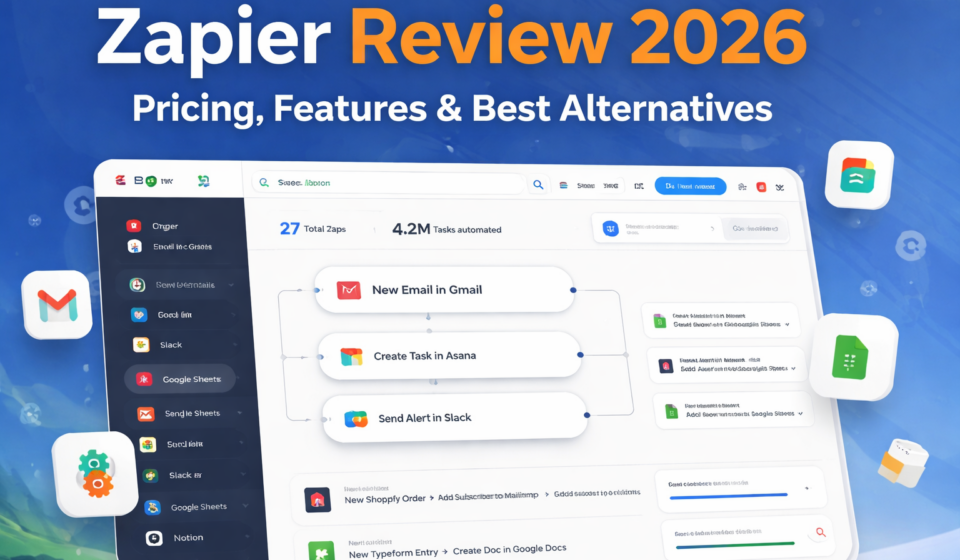
Zapier Review 2026: Features, Pricing & Best Alternatives
Introduction
Automation is no longer a luxury—it’s a necessity. According to a 2026 Gartner workflow automation report, over 70% of businesses now rely on some form of integration or automation platform to streamline operations. That raises an important question: is Zapier still the go-to solution in 2026, or has it been overtaken by newer, more flexible tools?
In this in-depth Zapier review 2026, we break down everything you need to know—from features and pricing to real user feedback and alternatives. Zapier has long been known as the easiest way to connect apps without coding, but the landscape has evolved rapidly with AI-powered automation, open-source tools, and enterprise-grade competitors.
Verdict upfront: Zapier remains one of the most accessible and powerful automation platforms in 2026—but it’s no longer the undisputed leader for every use case.
What Is Zapier and How Does It Work in 2026?
Zapier is a cloud-based automation platform that connects apps and services to automate workflows without requiring coding skills. Founded in 2011, it pioneered the concept of “Zaps”—automated workflows triggered by events.
How does Zapier work in 2026?
The core logic remains simple:
- Trigger – An event occurs (e.g., a new lead in a CRM)
- Action(s) – Zapier performs one or more actions (e.g., send email, update spreadsheet)
However, in 2026, Zapier has evolved far beyond simple automation:
- Multi-step workflows with branching logic
- AI-powered automation suggestions
- Natural language workflow creation
- Built-in data storage and tables
- Advanced logic paths (if/then conditions)
According to Zapier’s official February 2026 product update, over 6 million users now rely on the platform, with more than 7,000 app integrations available.
Key Features and Major Innovations in 2026
Zapier’s biggest strength in 2026 lies in its combination of simplicity and increasingly powerful features.
1. AI-Powered Automation Builder
One of the most significant upgrades is Zapier’s AI assistant:
- Create workflows using plain English prompts
- Auto-suggest workflows based on your app stack
- Generate multi-step automations instantly
Example:
“When a new Stripe payment happens, send a Slack message and log it in Airtable.”
Zapier builds it automatically.
[Insert screenshot of AI workflow builder here]
2. Zapier Interfaces (No-Code Apps)
Zapier Interfaces allows users to build simple web apps and internal tools:
- Forms, dashboards, and portals
- Connect directly to workflows
- Ideal for client onboarding or internal operations
3. Zapier Tables (Built-in Database)
Zapier now offers native data storage:
- Store structured data without external tools
- Trigger automations based on table changes
- Competes with Airtable-lite functionality
4. Advanced Logic and Paths
Automation is no longer linear:
- Conditional paths (if/else logic)
- Filters and branching workflows
- Looping actions for bulk processing
5. Massive Integration Library
Zapier integrations 2026 now exceed 7,000 apps, including:
- Google Workspace
- Slack
- Salesforce
- HubSpot
- Shopify
- OpenAI tools
Zapier Pricing Plans 2026
Zapier pricing 2026 remains one of its most debated aspects. While powerful, it can get expensive at scale.
Pricing Overview (as of March 2026)
[Add pricing comparison table here]
| Plan | Monthly Cost (Billed Annually) | Tasks/Month | Key Features |
|---|---|---|---|
| Free | $0 | 100 | Basic Zaps, 2-step workflows |
| Starter | ~$19.99 | 750 | Multi-step Zaps |
| Professional | ~$49 | 2,000 | Advanced logic, paths |
| Team | ~$69+ | 2,000+ | Collaboration tools |
| Enterprise | Custom | Unlimited | SSO, governance |
Value Analysis
- Best for individuals: Starter plan
- Best for SMBs: Professional plan
- Best for enterprises: Enterprise tier
According to G2 data (March 2026), pricing is the #1 complaint, especially for high-volume automation users.
Pros and Cons of Zapier
Pros
- Extremely beginner-friendly
- Massive integration ecosystem
- Reliable and stable platform
- AI-powered automation creation
- Strong documentation and support
Cons
- Expensive at scale
- Limited customization vs competitors
- Task-based pricing can be restrictive
- Slower execution vs some alternatives
- Not ideal for developers needing deep control
Zapier Integrations and Ecosystem in 2026
Zapier’s ecosystem remains its biggest competitive advantage.
Top Integrations
- CRM: Salesforce, HubSpot, Pipedrive
- Marketing: Mailchimp, ActiveCampaign
- E-commerce: Shopify, WooCommerce
- Productivity: Notion, Google Sheets, Slack
New Additions (2025–2026)
- Expanded AI tool integrations (OpenAI, Claude APIs)
- Webhook enhancements
- Better API support for custom apps
Limitations
- Some integrations are shallow (limited triggers/actions)
- Premium apps often require higher-tier plans
Real User Reviews and Ratings (G2, Capterra & TrustRadius Data)
Aggregate Ratings (as of March 2026)
- G2: 4.5/5 (based on 1,500+ reviews)
- Capterra: 4.7/5
- TrustRadius: 8.8/10
What Users Love
- Ease of use
- Time savings
- Integration coverage
Common Complaints
- Pricing structure
- Task limits
- Debugging complexity in large workflows
A January 2026 TrustRadius review notes:
“Zapier saves us dozens of hours weekly, but costs escalate quickly as automation scales.”
Zapier vs Top Alternatives in 2026
The competition is stronger than ever. Here’s how Zapier stacks up:
[Add comparison table here]
| Tool | Best For | Pricing | Key Strength |
|---|---|---|---|
| Zapier | Beginners & SMBs | High | Ease of use |
| Make (Integromat) | Advanced users | Moderate | Visual workflows |
| n8n | Developers | Low/free | Open-source flexibility |
| Microsoft Power Automate | Enterprises | Moderate | Deep Microsoft integration |
| IFTTT | Simple automations | Low | Consumer use |
Key Takeaways
- Zapier = easiest to use
- Make = more powerful workflows
- n8n = best for customization
- Power Automate = enterprise ecosystems
Best Use Cases and Industries for Zapier in 2026
Zapier excels in specific scenarios:
1. Small Businesses
- Lead management automation
- Email marketing workflows
- CRM syncing
2. Marketing Teams
- Campaign automation
- Social media scheduling
- Lead nurturing
3. E-commerce
- Order processing
- Customer notifications
- Inventory syncing
4. Agencies & Freelancers
- Client onboarding
- Reporting automation
- Workflow standardization
Recent News, Updates, and Future Outlook
Zapier has made significant moves recently:
- TechCrunch (Feb 2026): Zapier expanded its AI automation capabilities with natural language workflow creation
- Forbes (Dec 2025): Highlighted Zapier as a leader in no-code automation despite rising competition
- ZDNet (Jan 2026): Noted improvements in enterprise features and security
Future Outlook
- Deeper AI integration
- More native tools (databases, apps)
- Increased competition from open-source platforms
Who Should Use Zapier in 2026? (And Who Should Look Elsewhere?)
Best for:
- Non-technical users
- Small to mid-sized businesses
- Teams needing quick automation setup
- Marketers and operations teams
Not ideal for:
- Developers needing deep customization
- High-volume automation users on a budget
- Enterprises requiring complex orchestration
Conclusion and Final Verdict
So, is Zapier worth it in 2026?
Yes—but with caveats.
Zapier remains the most user-friendly automation platform available. Its AI features, massive integration library, and ease of use make it a top choice for beginners and growing businesses.
However, it’s no longer the best option for everyone. Pricing and scalability concerns mean that power users and developers may find better value in alternatives like Make or n8n.
Final Recommendation
- Choose Zapier if you want simplicity and speed
- Consider alternatives if you need power, flexibility, or cost efficiency
FAQ
1. What is Zapier used for in 2026?
Zapier is used to automate workflows between apps, reducing manual work and improving efficiency.
2. Is Zapier free in 2026?
Yes, but the free plan is limited to 100 tasks per month and basic features.
3. How does Zapier work in 2026?
It connects apps using triggers and actions, now enhanced with AI automation building.
4. What are the best Zapier alternatives in 2026?
Top alternatives include Make, n8n, Microsoft Power Automate, and IFTTT.
5. Is Zapier worth it in 2026?
Yes for ease of use and integrations, but expensive for high-volume workflows.
6. How many integrations does Zapier have in 2026?
Over 7,000 app integrations as of early 2026.
7. What industries benefit most from Zapier?
Marketing, e-commerce, SaaS, agencies, and small businesses.
8. Can Zapier replace developers?
Not entirely—it’s best for no-code automation, not complex system development.