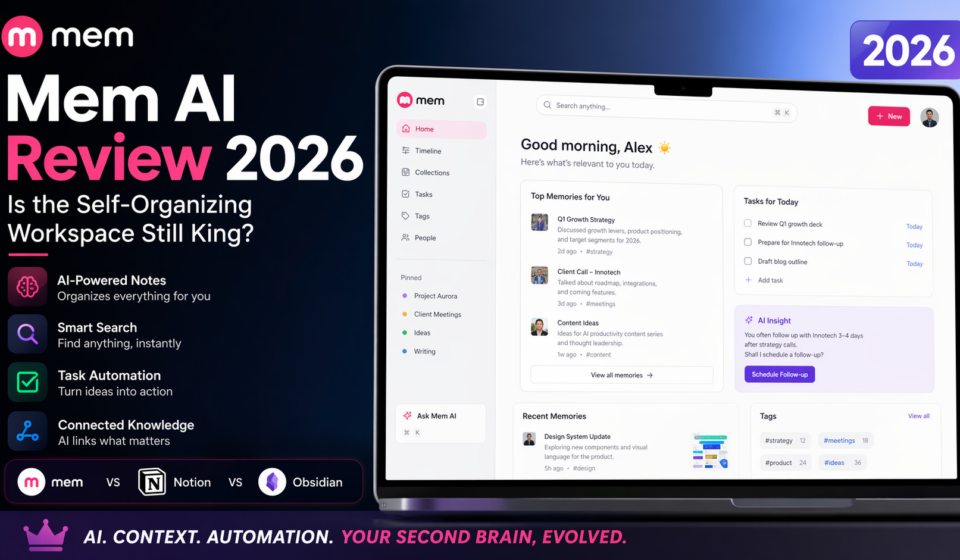
Mem AI Review 2026: Is the Self-Organizing Workspace Still King?
Introduction: The State of Personal Knowledge Management in 2026
Personal Knowledge Management (PKM) has undergone a quiet revolution over the past two years. What began as a productivity niche dominated by structured note-taking apps has evolved into a competitive AI battleground. In 2026, the idea of a “second brain” is no longer aspirational—it’s expected.
The biggest shift? Automation has replaced organization. Users no longer want to spend hours tagging, linking, and curating notes. Instead, they expect their tools to understand context, anticipate needs, and surface insights proactively.
This is the environment Mem AI now operates in.
Once hailed as the pioneer of the “self-organizing workspace,” Mem built its reputation on removing folders entirely and relying on AI to connect ideas. But as competitors like Notion and Obsidian have aggressively integrated AI—particularly with agentic workflows and local-first models—the question is no longer whether Mem is innovative.
It’s whether it’s still leading.
The ‘Self-Organizing’ Evolution: Mem’s 2026 Intelligence Layer
Mem’s core promise has always been simple: you write, it organizes. In 2026, that promise has evolved into something more ambitious—you think, it connects.
Context-Aware Memory Engine
The latest iteration of Mem Intelligence (rolled out in late 2025 and refined through early 2026) introduces deeper contextual awareness. Instead of relying primarily on keywords and backlinks, Mem now processes:
- Temporal context (when ideas were created and revisited)
- Behavioral signals (what you frequently reference together)
- Semantic clustering powered by hybrid LLM pipelines
The result is a system that doesn’t just retrieve notes—it predicts relevance.
For example, preparing for a client meeting will automatically surface:
- Past meeting notes
- Related documents
- Action items
- Even loosely connected ideas you may have forgotten
This predictive resurfacing is where Mem still feels ahead of many competitors.
Shift Toward Agentic AI
In 2026, Mem has leaned heavily into agent-based workflows. Instead of being a passive repository, it now supports semi-autonomous task execution:
- Auto-generating summaries from meeting notes
- Converting ideas into structured tasks
- Suggesting follow-ups based on past patterns
However, this shift is not without friction. While powerful, these features sometimes feel opaque. Users don’t always understand why certain suggestions appear, which can reduce trust in high-stakes workflows.
Key Features Deep-Dive
User Experience (UX)
Mem’s interface remains one of its strongest assets.
- Minimalist Design: No folders, no clutter—just a timeline and search
- Fast Capture: Near-instant note creation across devices
- Daily Notes System: Still central, but now enhanced with AI summaries
The 2026 update introduced subtle but impactful improvements:
- Smart formatting suggestions
- Inline AI assistance without breaking flow
- Adaptive layouts based on usage patterns
That said, the simplicity can still be polarizing. Power users migrating from more structured tools may find the lack of manual control limiting.
Search & Retrieval
Search is where Mem continues to shine.
- Natural Language Queries: Ask questions like “What did I decide about pricing last quarter?”
- Contextual Ranking: Results are prioritized based on relevance, not just keyword matches
- Dynamic Filters: Automatically suggested based on query intent
In real-world usage, Mem’s search feels closer to querying a knowledge assistant than browsing a database.
However, competitors have caught up significantly. Notion’s AI search and Obsidian’s plugin ecosystem now offer comparable—and sometimes more customizable—retrieval systems.
Task Automation & AI Workflows
Mem’s biggest leap in 2026 is in automation.
Key capabilities include:
- Auto Task Extraction: Converts notes into actionable to-dos
- Meeting Intelligence: Generates summaries, highlights decisions, and suggests next steps
- Workflow Suggestions: Recommends actions based on patterns (e.g., “You usually follow up with this contact”)
Where Mem excels:
- Seamless integration between notes and tasks
- Low setup friction
- Consistent AI assistance across workflows
Where it struggles:
- Limited customization compared to competitors
- Occasional overreach in suggestions
- Lack of transparency in AI decision-making
Mem vs Notion vs Obsidian (2026)
Mem vs Notion 2026
Notion has transformed dramatically with its 2025–2026 AI upgrades.
Notion Strengths:
- Highly customizable databases
- Strong collaborative features
- Advanced AI agents with workflow automation
Mem Strengths:
- Faster capture and retrieval
- Less setup required
- More intuitive for individual use
Verdict:
Notion wins for teams and structured workflows. Mem remains superior for frictionless personal knowledge capture.
Mem vs Obsidian 2026
Obsidian has doubled down on local-first architecture and modularity.
Obsidian Strengths:
- Full data ownership (local storage + local LLM support)
- Extensive plugin ecosystem
- Deep customization
Mem Strengths:
- Zero configuration
- Cloud-native intelligence
- Superior out-of-the-box experience
Verdict:
Obsidian is ideal for technical users and privacy-focused workflows. Mem is better for users who want intelligence without complexity.
Pricing & Value Proposition (2026)
Mem’s pricing structure saw notable adjustments in late 2025:
- Free Tier: Limited AI queries and storage
- Pro Plan (~$12–$15/month): Full AI features, higher usage limits
- Team Plan (introduced 2026): Early-stage, with collaboration features
Value Assessment
Compared to competitors:
- Slightly more expensive than basic note-taking tools
- Competitive with AI-powered platforms
- Justified if you actively use AI features
The real question is ROI. Mem delivers value when:
- You rely heavily on idea capture
- You want minimal setup
- You benefit from AI-driven recall
If you prefer structured systems or manual control, the value diminishes.
User Sentiment & Stability (Early 2026)
User feedback in early 2026 is mixed—but generally positive.
What Users Love
- Effortless note-taking experience
- Powerful search and recall
- Clean, distraction-free interface
Common Complaints
- Occasional AI inaccuracies
- Limited customization
- Concerns about long-term data portability
Stability has improved significantly compared to earlier versions. Performance is fast, sync is reliable, and major bugs are rare.
However, trust in AI-generated outputs remains a work in progress—especially for professional use cases.
The Verdict: Pros, Cons, and Who It’s For
Pros
- Best-in-class frictionless note capture
- Strong contextual search and retrieval
- Intelligent automation with minimal setup
- Clean, focused user experience
Cons
- Limited customization compared to competitors
- AI suggestions can feel opaque
- Less suited for complex project management
- Cloud-only approach may not appeal to privacy-focused users
Who Is Mem AI Best For in 2026?
Mem is ideal for:
- Founders and operators managing ideas and meetings
- Writers and researchers who value quick capture
- Professionals who want a “thinking partner” rather than a structured tool
It’s less ideal for:
- Teams needing robust collaboration systems
- Users who prefer manual organization
- Privacy-first or local-first advocates
Final Thoughts: Is Mem Still King?
Mem AI is no longer the only player in the self-organizing workspace category—but it remains one of the most refined.
Its biggest strength is still its philosophy: remove friction, let AI handle the rest.
In 2026, that philosophy holds up—but with caveats.
Competitors have caught up in AI capabilities and surpassed Mem in customization, collaboration, and transparency. Meanwhile, Mem’s push toward agentic AI introduces both power and unpredictability.
So, is it still king?
For simplicity and speed—yes.
For control and flexibility—no.
Mem AI isn’t trying to be everything. It’s trying to be effortless.
And for a specific type of user, that’s still exactly what wins.