DataRobot Review 2026: Pricing, Features, ROI & Comparison
Is this still the gold standard for enterprise AutoML—or being outpaced by cloud-native rivals?
The State of Enterprise AI in 2026
Enterprise AI in 2026 looks very different from even two years ago. The shift from experimentation to production-grade, ROI-driven AI has accelerated, driven by three forces:
- The rise of Agentic AI platforms capable of autonomous decision-making
- Increasing regulatory pressure (EU AI Act, HIPAA, industry governance)
- The demand for democratized AI tools that business users—not just data scientists—can operate
In this environment, DataRobot occupies a fascinating position. It’s no longer just an AutoML vendor—it’s repositioning itself as a full-stack AI platform competing with hyperscalers and modern data platforms.
As of March 2026:
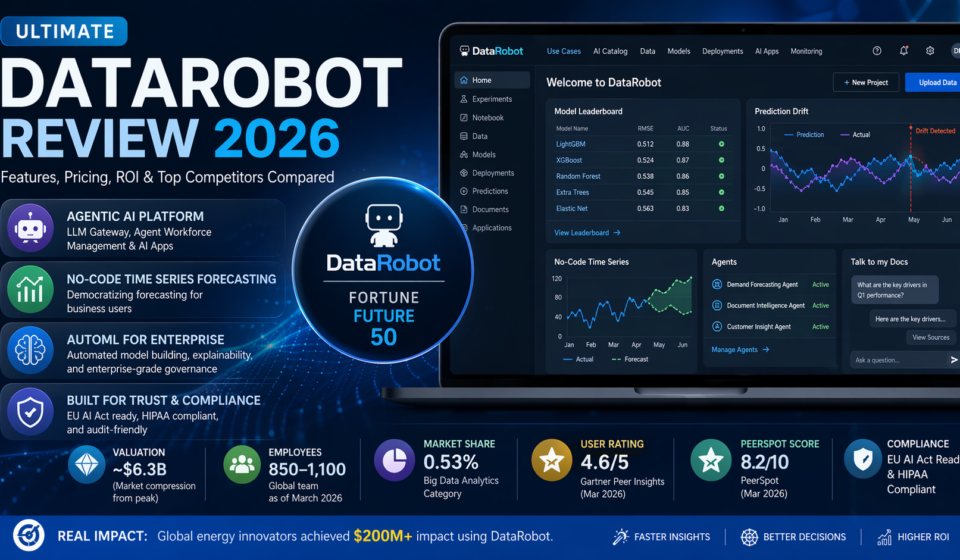
- Valuation: ~$6.3B (down from peak levels, reflecting broader market compression)
- Employees: ~850–1,100
- Recognition: Named to the Fortune Future 50
- Market Share: ~0.53% in Big Data Analytics (vs. Databricks at 17.69%)
- User Ratings: 4.6/5 (Gartner Peer Insights), 8.2/10 (PeerSpot)
This review breaks down whether DataRobot still delivers elite value—or if it’s becoming a premium niche tool in a cloud-dominated market.
Core Platform Overview
DataRobot’s platform in 2026 revolves around three pillars:
- AutoML for Enterprise
- AI Workbench (developer + MLOps layer)
- Agentic AI Suite (new in 2025–2026)
1. AutoML for Enterprise (Still Best-in-Class)
DataRobot built its reputation on AutoML, and that foundation remains strong.
What it does well:
- Automated feature engineering
- Model selection across hundreds of algorithms
- Built-in validation, drift detection, and governance
- Explainability layers for regulated industries
Why it still matters:
In 2026, AutoML isn’t novel—but enterprise-grade AutoML with governance baked in still is.
DataRobot excels at:
- Standardizing model development across large teams
- Reducing dependency on highly specialized ML talent
- Accelerating deployment timelines from months to weeks
2. AI Workbench: Bridging Data Science and Production
DataRobot Workbench has evolved into a serious competitor to notebook-based workflows.
Key capabilities:
- Collaborative model development
- Experiment tracking and lineage
- Deployment pipelines with monitoring
- Integration with Python, R, and SQL workflows
Unlike lightweight notebook tools, Workbench is tightly integrated with:
- Governance frameworks
- Model lifecycle management
- Enterprise authentication systems
This makes it particularly attractive for:
- Banks
- Healthcare organizations
- Insurance firms
2025–2026 Breakthrough Features
No-Code Time Series Platform (July 2025)
One of DataRobot’s most impactful updates is its No-code time series forecasting platform.
What changed?
Traditionally, time series modeling required:
- Statistical expertise (ARIMA, SARIMA, Prophet)
- Data preprocessing knowledge
- Manual tuning
Now, DataRobot enables:
- Drag-and-drop forecasting workflows
- Automated lag feature generation
- Scenario-based forecasting
Why this matters:
This is a major leap in no-code time series forecasting, enabling:
- Supply chain managers to predict demand
- Finance teams to model revenue scenarios
- Operations teams to forecast resource needs
Impact:
It significantly lowers the barrier to predictive analytics adoption across non-technical departments.
Agentic AI Platform (Late 2025 Launch)
This is where DataRobot is betting its future.
The Agentic AI platform transforms the system from a model builder into an AI workforce orchestration layer.
Key components:
1. LLM Gateway
- Centralized interface for managing large language models
- Controls access, cost, and compliance
- Enables switching between providers (OpenAI, open-source, etc.)
2. Agent Workforce Management
- Define AI agents for specific business tasks
- Monitor performance and behavior
- Assign roles and workflows
Think of it as:
“MLOps for AI agents”
3. “Talk to My Docs” Template
- Prebuilt application for document-based Q&A
- Uses vector databases + LLMs
- Enterprise-ready with security controls
Technical Integrations (2026 Stack Depth)
DataRobot has significantly expanded its ecosystem.
NVIDIA NIM Integration
- Access to 60+ GPU-optimized containers
- Preconfigured AI workloads
- Faster inference and deployment
Vector Database Support
Supports:
- Milvus
- Pinecone
- Elasticsearch
This is critical for:
- Retrieval-Augmented Generation (RAG)
- Enterprise search
- Knowledge assistants
Pricing Analysis (2026 Reality Check)
DataRobot pricing remains one of its most debated aspects.
Typical Cost Structure
| Deployment Type | Annual Cost |
|---|---|
| Small cloud teams | ~$100,000+ |
| Mid-market deployments | $250,000–$600,000 |
| Enterprise (large-scale) | $1M+ (custom) |
Hidden Costs to Watch
- Compute Overages
- Typically 15–30% above base cost
- Driven by model training and inference workloads
- Professional Services
- Implementation, onboarding, and customization
- Often required for enterprise deployments
- Data Infrastructure Costs
- Storage, pipelines, and integrations
Pricing Verdict
DataRobot is:
- Not budget-friendly
- Positioned as a premium enterprise solution
However, for organizations that fully utilize the platform, the ROI can justify the spend.
ROI and Business Impact
One of DataRobot’s strongest selling points is measurable ROI.
Real-World Impact Example:
- A global energy innovator achieved $200M+ business impact
through predictive optimization and forecasting
Where ROI Comes From:
- Faster model deployment (weeks vs months)
- Reduced data science labor costs
- Improved decision-making accuracy
- Automation of repetitive analytics tasks
Compliance and Governance Strength
In 2026, compliance is no longer optional—it’s a core buying factor.
DataRobot excels in:
- EU AI Act readiness
- HIPAA compliance
- Model explainability and audit trails
- Bias detection and mitigation tools
This makes it a top choice for:
- Healthcare
- Financial services
- Government agencies
Pros and Cons (2026 User Sentiment)
Pros
1. Ease of Use
Even complex workflows are accessible to non-experts.
2. Enterprise-Grade Governance
Best-in-class compliance features.
3. End-to-End Platform
Covers everything from data to deployment to monitoring.
4. Strong AutoML Capabilities
Still among the best in the market.
Cons
1. “Black Box” Concerns
Some users feel:
- Limited transparency in model selection
- Reduced control compared to custom ML pipelines
2. High Cost
Pricing is a major barrier for:
- Startups
- Smaller teams
3. Market Share Limitations
At ~0.53%, it remains a niche player compared to:
- Databricks
- AWS
DataRobot vs Competitors (2026)
DataRobot vs Databricks (2026)
| Feature | DataRobot | Databricks |
|---|---|---|
| Pricing | Fixed + custom | Consumption-based |
| Ease of Use | Very high | Moderate |
| Flexibility | Medium | Very high |
| Best For | Enterprise AI automation | Data engineering + ML at scale |
Verdict:
Databricks wins for flexibility and scale.
DataRobot wins for ease and speed.
DataRobot vs AWS SageMaker
| Feature | DataRobot | SageMaker |
|---|---|---|
| Setup Complexity | Low | High |
| Cost Efficiency | Lower | High (for AWS users) |
| Integration | Broad | Deep AWS-native |
Verdict:
SageMaker is ideal if you’re already deep in AWS.
DataRobot is better for cross-cloud simplicity.
DataRobot vs H2O.ai
| Feature | DataRobot | H2O.ai |
|---|---|---|
| Pricing | High | Lower |
| Target Market | Enterprises | Startups + mid-market |
| Customization | Moderate | High |
Verdict:
H2O.ai is more accessible.
DataRobot is more polished and enterprise-ready.
Predictive Analytics ROI: Is It Worth It?
When evaluating Predictive Analytics ROI, the key question is:
Are you replacing manual, fragmented workflows—or enhancing an already mature ML stack?
DataRobot delivers maximum ROI when:
- Teams lack deep ML expertise
- Speed-to-production is critical
- Compliance requirements are strict
- AI adoption is organization-wide
It delivers less value when:
- You already have a strong ML engineering team
- You prefer open-source customization
- Cost efficiency is your top priority
Who Should Buy DataRobot in 2026?
Ideal Buyers
1. Large Enterprises
- Complex workflows
- Multiple teams
- Need for governance
2. Regulated Industries
- Healthcare
- Banking
- Insurance
3. Organizations Scaling AI Rapidly
- Want standardized processes
- Need quick deployment
Not Ideal For
- Startups with limited budgets
- Highly technical teams preferring full control
- Organizations already deeply invested in Databricks or AWS ecosystems
Final Verdict: DataRobot Review 2026
DataRobot in 2026 is no longer just an AutoML tool—it’s a full enterprise AI operating system.
Strengths:
- Industry-leading usability
- Strong compliance and governance
- Rapid innovation in Agentic AI
Weaknesses:
- Premium pricing
- Limited flexibility compared to cloud-native platforms
- Smaller market footprint
Bottom Line
If your organization values:
- Speed
- Simplicity
- Governance
Then DataRobot remains one of the most compelling AutoML for Enterprise platforms available.
But if you prioritize:
- Cost optimization
- Custom engineering
- Deep cloud integration
Then competitors like Databricks or AWS SageMaker may be a better fit.
Final Rating: ★★★★☆ (4.5/5)
DataRobot continues to justify its premium positioning—but only for organizations ready to fully leverage its capabilities.