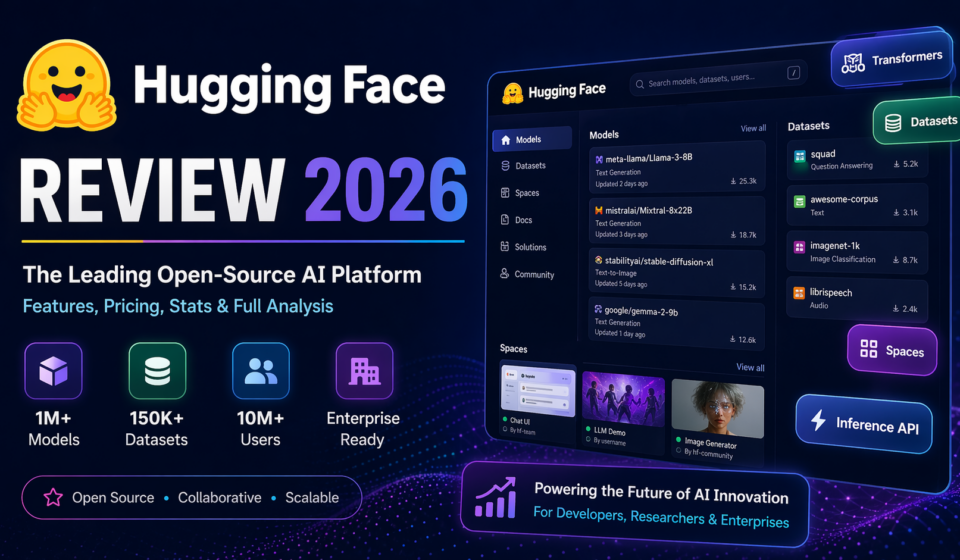
Hugging Face Review 2026: A Complete Deep Dive into the Leading AI Platform
Introduction
The AI landscape has evolved dramatically over the past few years, and few platforms have played as central a role as Hugging Face. Once known primarily for its transformer models, it has now grown into a full-fledged AI ecosystem powering developers, enterprises, and researchers worldwide.
In this Hugging Face Review 2026, we take a deep, research-driven look at the platform—its features, growth metrics, pricing, real-world applications, and future outlook. Whether you’re a developer, startup founder, or AI enthusiast, this guide provides a comprehensive understanding of the Hugging Face AI platform.
What is Hugging Face?
Hugging Face is an open-source AI platform that provides tools, models, and infrastructure for building, training, and deploying machine learning applications—particularly in natural language processing (NLP), computer vision, and multimodal AI.
Initially launched as a chatbot company, Hugging Face pivoted to become the “GitHub of machine learning,” offering a collaborative hub for AI models and datasets.
Core Offerings:
- Model Hub (pre-trained models)
- Datasets library
- Transformers library
- Spaces (AI app hosting)
- Inference API & Endpoints
By 2026, Hugging Face has become a critical layer in the global AI infrastructure stack.
Key Features of Hugging Face (2026)
1. Massive Model Hub
- Millions of open-source models available
- Covers NLP, vision, audio, and multimodal AI
- Supports models from major organizations and independent developers
2. Transformers Library
- Industry-standard library for deep learning models
- Supports frameworks like PyTorch, TensorFlow, and JAX
- Easy fine-tuning and deployment workflows
3. Hugging Face Spaces
- Build and deploy AI apps using:
- Gradio
- Streamlit
- Docker
- Ideal for demos, prototypes, and production apps
4. Datasets Library
- Thousands of curated datasets
- Efficient data loading and preprocessing tools
- Supports large-scale distributed training
5. Inference Endpoints
- Dedicated infrastructure for model deployment
- Scalable APIs for real-time inference
- Enterprise-grade reliability
6. Collaboration & Versioning
- Git-based version control for models and datasets
- Team collaboration tools
- Model evaluation and benchmarking
Latest Statistics & Growth in 2026
Hugging Face has experienced explosive growth, reflecting the global surge in AI adoption.
Key Data Points (2026):
- Models hosted: 1,000,000+
- Datasets available: 150,000+
- Registered users: 10+ million
- Monthly active users: Estimated 3–5 million
- Enterprise clients: Thousands, including Fortune 500 companies
- Funding: Over $395 million raised (latest rounds included major tech investors)
Growth Trends:
- Rapid adoption of open-source LLMs
- Surge in multimodal AI models
- Increased enterprise shift toward self-hosted AI solutions
- Expansion into AI infrastructure and deployment tools
Hugging Face is no longer just a model repository—it’s a full-stack AI platform.
Use Cases of Hugging Face
For Developers
- Build NLP applications (chatbots, summarizers, translators)
- Fine-tune pre-trained models
- Deploy APIs quickly using inference endpoints
For Enterprises
- Develop internal AI tools
- Deploy private models securely
- Reduce dependency on proprietary AI providers
For Researchers
- Access cutting-edge models and datasets
- Share research outputs openly
- Collaborate globally
For Startups
- Rapid prototyping of AI products
- Cost-effective infrastructure
- Faster time-to-market
Pros and Cons of Hugging Face
Pros
- ✅ Huge open-source ecosystem
- ✅ Easy access to pre-trained models
- ✅ Strong developer community
- ✅ Flexible deployment options
- ✅ Supports multiple frameworks
- ✅ Transparent and collaborative
Cons
- ❌ Steeper learning curve for beginners
- ❌ Infrastructure costs can rise at scale
- ❌ Quality of models varies widely
- ❌ Requires optimization for production use
Hugging Face Pricing (2026)
Hugging Face follows a freemium model, making it accessible while offering scalable enterprise solutions.
Free Tier
- Access to public models and datasets
- Limited API usage
- Community features
Pro Plan (Individual)
- Priority access to resources
- Faster inference
- Advanced collaboration features
Enterprise Plans
- Dedicated inference endpoints
- Private model hosting
- Enhanced security and compliance
- Custom SLAs and support
Cost Considerations
- Pricing depends on:
- Compute usage
- Storage
- API calls
- GPU-based inference can increase costs significantly
Hugging Face vs Competitors
1. OpenAI
- Proprietary models vs open-source ecosystem
- Easier APIs but less flexibility
- Hugging Face offers more customization
2. Google AI / Vertex AI
- Strong infrastructure and integration
- More enterprise-focused
- Hugging Face excels in community and openness
3. AWS AI Services
- Scalable cloud solutions
- Complex pricing structure
- Hugging Face is more developer-friendly
4. Cohere / Anthropic
- Focused on LLM APIs
- Less ecosystem breadth compared to Hugging Face
Key Differentiator:
Hugging Face stands out due to its open-source-first approach and community-driven innovation.
Real-World Applications & Ecosystem Trends
1. Generative AI Applications
- Text generation tools
- AI writing assistants
- Code generation systems
2. Multimodal AI
- Image-to-text models
- Video understanding systems
- Speech-to-text applications
3. Enterprise AI Adoption
- Internal knowledge assistants
- Customer support automation
- Document processing systems
4. Open-Source AI Movement
- Organizations moving away from closed APIs
- Greater focus on transparency and control
5. AI Democratization
- Individuals can build advanced AI apps without massive resources
- Lower barrier to entry for startups
Challenges & Limitations
Despite its strengths, Hugging Face faces several challenges:
1. Model Quality Control
- Open platform means inconsistent quality
- Requires evaluation before use
2. Infrastructure Complexity
- Scaling models requires expertise
- Deployment optimization can be difficult
3. Competition from Big Tech
- Strong competition from cloud providers
- Proprietary models with better performance in some cases
4. Monetization Balance
- Maintaining open-source ethos while scaling revenue
Future Outlook (2026 and Beyond)
The future of Hugging Face looks promising as AI adoption continues to accelerate.
Key Predictions:
- Expansion into AI infrastructure services
- Growth in enterprise AI solutions
- Stronger focus on multimodal models
- Increased integration with edge computing
- Continued leadership in open-source AI
Hugging Face is likely to remain a central hub in the AI ecosystem, especially as demand for transparency and customization grows.
Final Verdict: Is Hugging Face Worth It in 2026?
In this Hugging Face Review 2026, it’s clear that the platform has evolved into one of the most important players in the AI space.
Best For:
- Developers seeking flexibility
- Startups building AI products
- Enterprises exploring open-source AI
- Researchers and academics
Overall Rating: ⭐ 4.7 / 5
Hugging Face stands out for its:
- Open ecosystem
- Massive model library
- Strong community
- Continuous innovation
While it requires technical expertise and careful implementation, its advantages far outweigh its limitations.
Conclusion
Hugging Face is no longer just a tool—it’s an ecosystem shaping the future of artificial intelligence. As of 2026, it offers unmatched access to models, datasets, and collaborative tools that empower anyone to build AI-driven solutions.
For those willing to invest time in learning and optimization, Hugging Face remains one of the most powerful platforms in the AI landscape today.