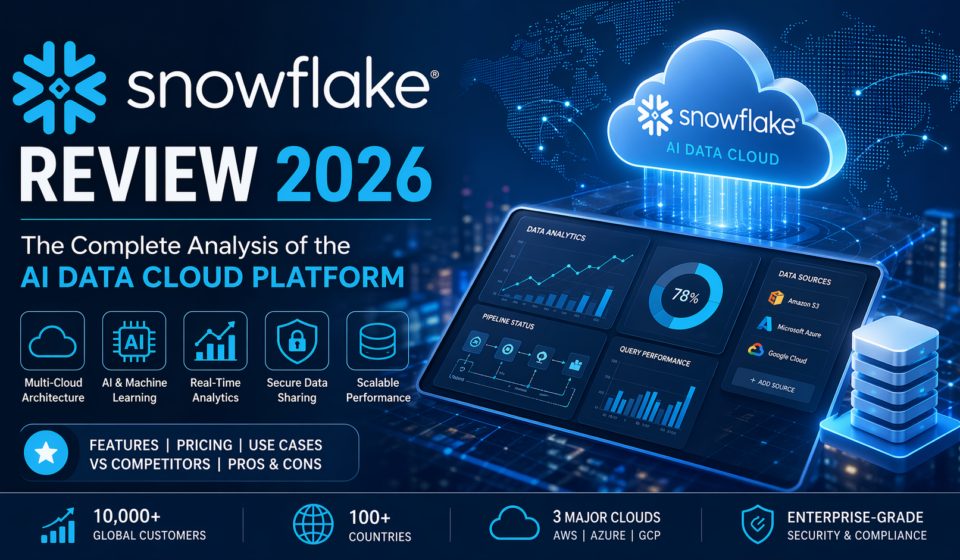
Snowflake Review 2026: Complete Analysis of the AI Data Cloud Platform
Introduction
In 2026, data is no longer just an asset—it’s the backbone of AI-driven decision-making. Businesses across industries are rapidly shifting toward platforms that can unify, analyze, and scale data efficiently. This is where Snowflake Inc. continues to stand out.
Originally known for its cloud data warehousing capabilities, Snowflake has evolved into a powerful AI Data Cloud platform. With increasing competition from platforms like Databricks and Google BigQuery, Snowflake’s innovations in AI, scalability, and cross-cloud integration make it a critical player in 2026.
This in-depth review explores Snowflake’s latest features, pricing, performance, and whether it remains a top choice for businesses in the AI era.
What is Snowflake?
Snowflake is a cloud-based data platform that enables organizations to store, process, and analyze large volumes of structured and semi-structured data. Unlike traditional data warehouses, Snowflake operates on a multi-cloud architecture, running seamlessly on platforms like Amazon Web Services, Microsoft Azure, and Google Cloud Platform.
Core Concept: AI Data Cloud
By 2026, Snowflake has positioned itself as an AI-first data cloud, allowing businesses to:
- Integrate data from multiple sources
- Build and deploy AI/ML models
- Share and monetize data securely
- Run real-time analytics at scale
This transformation reflects the growing demand for unified data + AI ecosystems.
Key Features of Snowflake (2026)
Snowflake’s feature set has expanded significantly to support AI workloads and enterprise-scale analytics.
🔹 1. Native AI & Machine Learning Integration
- Built-in support for AI model training and deployment
- Integration with popular frameworks like Python, TensorFlow, and PyTorch
- Snowflake Cortex (AI layer) for generative AI use cases
🔹 2. Multi-Cloud Architecture
- Run workloads across AWS, Azure, and GCP
- Avoid vendor lock-in
- Seamless cross-cloud data sharing
🔹 3. Data Sharing & Marketplace
- Secure, real-time data sharing without duplication
- Access to Snowflake Data Marketplace for third-party datasets
🔹 4. Separation of Storage and Compute
- Independent scaling of storage and compute resources
- Improved performance and cost optimization
🔹 5. Real-Time Data Processing
- Supports streaming data pipelines
- Near real-time analytics for modern applications
🔹 6. Strong Security Framework
- End-to-end encryption
- Role-based access control (RBAC)
- Compliance with global standards
Latest Updates & Innovations (2026)
Snowflake has introduced several major updates in 2025–2026, strengthening its AI and enterprise capabilities.
🚀 AI Advancements
- Launch of Snowflake Cortex AI for building generative AI apps
- Integration with large language models (LLMs)
- Native vector search capabilities for AI workloads
🤝 Strategic Partnerships
Snowflake has expanded collaborations with:
- NVIDIA for accelerated AI computing
- OpenAI for advanced AI integrations
- Major enterprise SaaS platforms for data interoperability
📊 Enterprise Adoption Trends
- Increased adoption in finance, healthcare, and retail sectors
- Growth in AI-driven analytics use cases
- Expansion into mid-sized business markets
Snowflake Pricing & Cost Model
Snowflake follows a consumption-based pricing model, which differs from traditional subscription systems.
💰 Pricing Components
- Compute Costs: Based on virtual warehouse usage
- Storage Costs: Pay for data stored
- Data Transfer Costs: Charges for cross-region/cloud movement
👍 Advantages
- Pay only for what you use
- Scalable for businesses of all sizes
- Transparent usage tracking
👎 Disadvantages
- Costs can increase rapidly without monitoring
- Complex pricing structure for beginners
In 2026, Snowflake has introduced improved cost governance tools, helping businesses track and optimize spending more effectively.
Performance & Scalability
Performance remains one of Snowflake’s strongest areas.
⚡ Key Strengths
- Automatic query optimization
- High concurrency handling
- Near-instant scaling of compute resources
🌐 Multi-Cloud Performance
Snowflake’s ability to operate across multiple cloud providers ensures:
- High availability
- Disaster recovery
- Global data access
Real-world benchmarks show Snowflake performing exceptionally well in:
- Large-scale analytics
- AI model training pipelines
- Data-heavy enterprise workloads
Pros and Cons
✅ Pros
- Highly scalable architecture
- Strong AI and machine learning integration
- Multi-cloud flexibility
- Secure data sharing capabilities
- Minimal infrastructure management
❌ Cons
- Pricing complexity
- Learning curve for beginners
- Heavy reliance on cloud ecosystem
Snowflake vs Competitors
Snowflake operates in a highly competitive market. Here’s how it compares:
🔍 Snowflake vs Databricks
- Snowflake: Better for structured analytics and SQL workloads
- Databricks: Stronger in data science and ML pipelines
🔍 Snowflake vs Google BigQuery
- Snowflake: Multi-cloud flexibility
- BigQuery: Deep integration with Google ecosystem
🔍 Snowflake vs Amazon Redshift
- Snowflake: Easier scalability and maintenance
- Amazon Redshift: Better for AWS-native environments
🏆 Verdict
Snowflake stands out for its ease of use, flexibility, and AI integration, making it a balanced choice across use cases.
Use Cases
Snowflake supports a wide range of real-world applications:
📊 Business Intelligence & Analytics
- Data dashboards and reporting
- Real-time decision-making
🤖 AI & Machine Learning
- Predictive analytics
- Generative AI applications
🛒 Retail & E-commerce
- Customer behavior analysis
- Personalized recommendations
🏥 Healthcare
- Patient data analysis
- Predictive diagnostics
💳 Financial Services
- Fraud detection
- Risk analysis
Security & Compliance
Security is a top priority for Snowflake in 2026.
🔐 Key Security Features
- End-to-end encryption
- Multi-factor authentication (MFA)
- Role-based access control
📜 Compliance Standards
Snowflake complies with major regulations such as:
- GDPR
- HIPAA
- SOC 2
🛡️ Data Governance
- Fine-grained access controls
- Data masking and tokenization
- Audit logging
Who Should Use Snowflake?
Snowflake is ideal for:
👨💼 Enterprises
- Large-scale data operations
- Multi-cloud strategies
👩💻 Developers & Data Engineers
- Building data pipelines
- AI/ML model deployment
📈 Startups
- Scalable infrastructure without heavy upfront costs
🏢 Mid-Sized Businesses
- Advanced analytics without complex infrastructure
Final Verdict (2026 Review)
Snowflake in 2026 is no longer just a data warehouse—it’s a comprehensive AI Data Cloud platform. Its ability to combine data storage, analytics, and AI capabilities in a single ecosystem makes it highly valuable for modern businesses.
⭐ Overall Rating: 4.6 / 5
✔️ Why Choose Snowflake in 2026?
- Strong AI integration
- Flexible multi-cloud architecture
- High performance and scalability
⚠️ Considerations
- Monitor costs carefully
- Requires some technical expertise
🏁 Final Thoughts
If your organization is looking to leverage data + AI at scale, Snowflake remains one of the most powerful and future-ready platforms available today.