Databricks Review 2026: Features, Pricing, Performance & Real-World Insights
Introduction
In this Databricks Review 2026, we take a comprehensive look at one of the most influential platforms in the modern data ecosystem. As organizations race to unify analytics, machine learning, and generative AI, Databricks has positioned itself at the center of this transformation.
By 2026, the convergence of data engineering, analytics, and AI is no longer optional—it’s foundational. Databricks has evolved from a Spark-based analytics platform into a full-fledged Data Intelligence Platform, enabling enterprises to build, deploy, and scale AI solutions on unified data architecture.
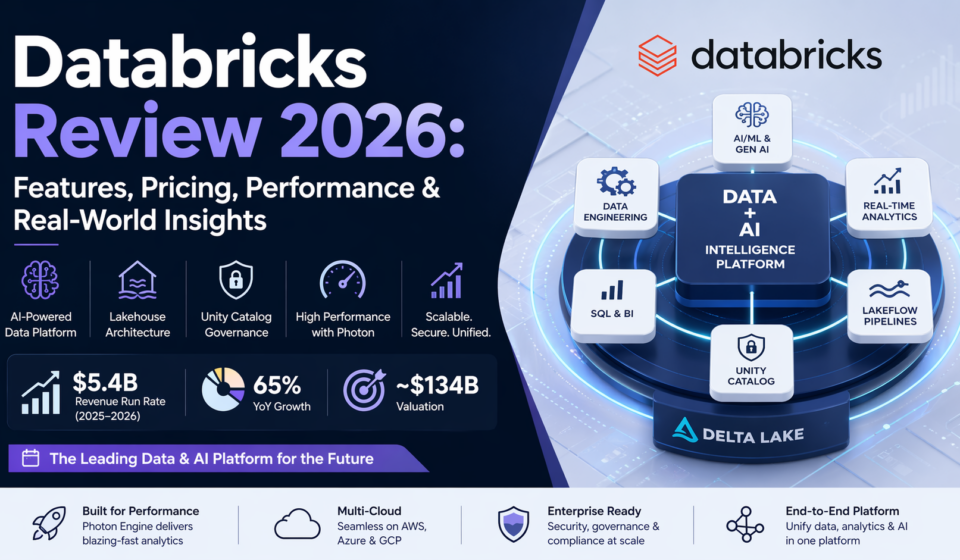
With an estimated $5.4 billion revenue run rate, ~65% year-over-year growth, and a valuation nearing $134 billion, Databricks is not just growing—it’s reshaping the data stack.
What is Databricks?
Databricks is a cloud-based platform designed to unify data, analytics, and AI workloads into a single environment. It was originally built by the creators of Apache Spark but has since evolved far beyond its roots.
Lakehouse Architecture Explained
At the core of Databricks is the Lakehouse architecture, which combines:
- The flexibility of data lakes
- The performance and governance of data warehouses
This architecture eliminates the need for separate systems, enabling:
- Structured and unstructured data storage
- Real-time analytics
- AI and machine learning on the same platform
Key benefit: No data duplication between systems, reducing cost and complexity.
Key Features of Databricks (2026)
1. Unified Data + AI Platform
Databricks has fully embraced its identity as a Databricks AI platform, offering:
- Data engineering pipelines
- Data warehousing capabilities
- Machine learning workflows
- Generative AI and LLM integration
Everything runs on a single platform with shared governance.
2. Delta Lake & Lakehouse Architecture
Delta Lake remains the backbone of Databricks:
- ACID transactions on data lakes
- Schema enforcement and evolution
- Time travel for data versioning
In 2026, Delta Lake has become more optimized for:
- Streaming + batch unification
- Large-scale AI training datasets
3. Unity Catalog (Data Governance)
Unity Catalog is Databricks’ centralized governance layer, now a critical enterprise feature.
Capabilities include:
- Fine-grained access control
- Data lineage tracking
- Cross-cloud data sharing
- Centralized metadata management
In 2026, enhancements include:
- Automated compliance monitoring
- AI-powered data classification
- Multi-region governance controls
4. AI/ML Capabilities (MLflow, Genie AI, LLMs)
Databricks continues to lead in AI integration.
Core tools:
- MLflow for experiment tracking and model lifecycle
- Genie AI (newer addition): conversational AI assistant for data workflows
- Native support for LLMs and foundation models
2026 upgrades:
- Fine-tuning pipelines for enterprise LLMs
- Built-in vector search capabilities
- AI agents integrated directly into workflows
5. SQL & BI Tools
Databricks SQL has matured significantly, making it a serious competitor to traditional warehouses.
Recent improvements:
- SQL scripting support (2026 release)
- Advanced parameterization
- Improved dashboarding and query performance
- Native BI integrations
6. Lakeflow Pipelines
Lakeflow is Databricks’ modern pipeline orchestration system.
Features:
- Declarative pipeline building
- Automated schema evolution
- Built-in observability tools
2026 updates include:
- Smarter pipeline optimization using AI
- Real-time anomaly detection
- Enhanced streaming capabilities
7. Serverless & Performance Enhancements
Databricks now offers extensive serverless compute options, reducing operational overhead.
Highlights:
- Auto-scaling clusters
- Pay-per-use execution
- Faster startup times
Combined with the Photon engine, performance has improved dramatically.
What’s New in Databricks (2026 Updates)
Databricks continues rapid innovation, especially in AI and automation.
Key 2026 Enhancements
1. AI-Driven Workflows
- Automated pipeline generation
- AI-assisted debugging and optimization
- Intelligent query suggestions
2. SQL Advancements
- Full SQL scripting support
- Dynamic parameter handling
- Enhanced performance tuning
3. Lakeflow Improvements
- Better schema evolution handling
- Unified batch + streaming pipelines
- More granular monitoring tools
4. New Platform Capabilities
- Lakebase (emerging database layer for operational workloads)
- Deeper LLM integrations
- Expanded partner ecosystem
Pricing & Cost Structure
Understanding Databricks pricing is essential—it’s powerful but can be complex.
Pricing Model Overview
Databricks uses a consumption-based model:
- Charges based on Databricks Units (DBUs)
- Additional cloud infrastructure costs (AWS, Azure, GCP)
- Separate pricing for:
- Compute
- Storage
- Data transfer
Pay-As-You-Go Compute
Costs depend on:
- Cluster size and type
- Workload intensity
- Runtime (hours used)
Serverless options simplify pricing but may still require optimization.
Cost Challenges
Common concerns include:
- Difficulty predicting costs
- High expenses for large-scale workloads
- Need for active cost monitoring
Cost Optimization Tips
- Use auto-scaling clusters
- Optimize job scheduling
- Leverage spot instances (where available)
- Monitor DBU usage regularly
Performance & Scalability
Performance is one of Databricks’ strongest advantages.
Photon Engine
Photon is a vectorized query engine designed to accelerate SQL workloads.
Benefits:
- Faster query execution (often 2–5x improvements)
- Reduced compute costs
- Better concurrency handling
Distributed Computing Power
Databricks excels in:
- Large-scale data processing
- Real-time streaming analytics
- Parallel machine learning training
Enterprise Scalability
Databricks supports:
- Petabyte-scale data
- Thousands of concurrent users
- Multi-cloud deployments
It is particularly strong in enterprise environments with complex data needs.
Pros and Cons
Pros
- Unified platform for data + AI
- Strong performance with Photon engine
- Advanced ML and AI capabilities
- Robust governance via Unity Catalog
- Flexible, scalable architecture
Cons
- Complex pricing structure
- Steep learning curve for beginners
- Requires cloud expertise
- Cost can escalate quickly without optimization
- Some BI features still catching up to specialized tools
Use Cases
Databricks is highly versatile across industries.
1. Data Engineering
- ETL/ELT pipelines
- Data transformation at scale
- Streaming data ingestion
2. Machine Learning
- Model training and deployment
- Experiment tracking with MLflow
- LLM fine-tuning and inference
3. Business Intelligence
- SQL analytics
- Dashboard creation
- Data exploration
4. Real-Time Analytics
- Fraud detection
- IoT data processing
- Event-driven analytics
Databricks vs Competitors
Databricks vs Snowflake
- Databricks: Strong in AI/ML and unified workloads
- Snowflake: Simpler data warehousing experience
Verdict: Databricks wins for AI-heavy use cases.
Databricks vs Google BigQuery
- BigQuery: Serverless simplicity
- Databricks: More flexible and powerful for complex pipelines
Verdict: BigQuery is easier; Databricks is more versatile.
Databricks vs AWS Redshift
- Redshift: Traditional warehouse
- Databricks: Modern lakehouse architecture
Verdict: Databricks is more future-proof.
Real-World Adoption & Market Position
Databricks has seen explosive growth:
- $5.4B revenue run rate (2025–2026)
- ~65% YoY growth
- $134B valuation
Enterprise Adoption
Used by:
- Fortune 500 companies
- Tech, finance, healthcare, and retail sectors
Market Trends
- Increasing demand for unified data + AI platforms
- Shift away from siloed architectures
- Growing importance of generative AI integration
Databricks is leading this shift.
Is Databricks Worth It in 2026?
Best For:
- Large enterprises with complex data needs
- AI/ML-driven organizations
- Teams needing unified data architecture
Not Ideal For:
- Small teams with limited budgets
- Simple analytics use cases
- Organizations without cloud expertise
Overall Verdict
Databricks is one of the most powerful platforms available—but it’s not the simplest or cheapest.
If your organization is investing in AI and large-scale data, it’s a top-tier choice.
Conclusion
This Databricks Review 2026 highlights a platform that has evolved into a leader in the data + AI convergence era.
With innovations like:
- Unity Catalog governance
- Lakeflow pipelines
- Genie AI
- Advanced SQL capabilities
Databricks is pushing the boundaries of what a data platform can do.
Final Thoughts
- Strength: Unmatched flexibility and AI integration
- Weakness: Cost and complexity
- Future Outlook: Extremely strong, especially with AI-driven workflows
As data and AI continue to merge, Databricks is well-positioned to remain a dominant force through 2026 and beyond.