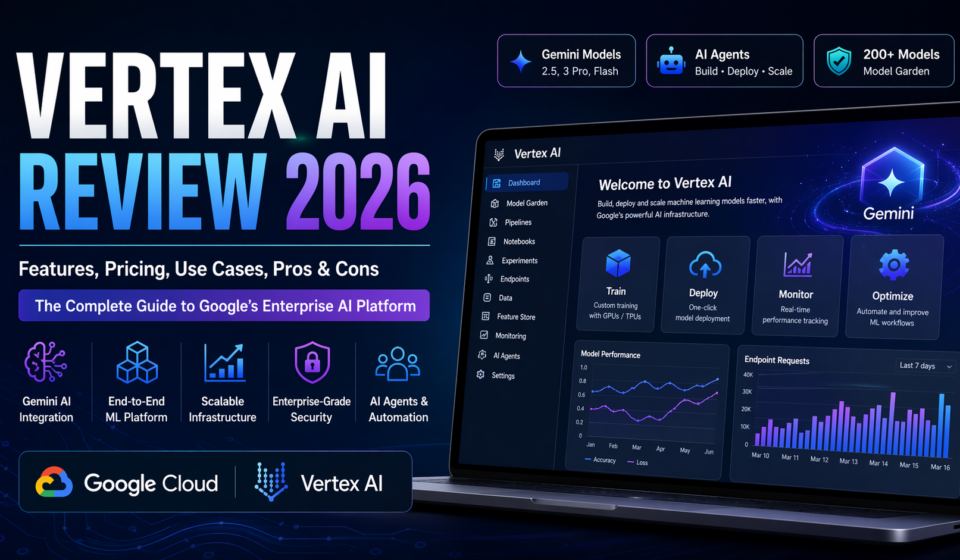
Vertex AI Review 2026: Features, Pricing, Use Cases, Pros & Cons
Introduction
Artificial Intelligence platforms have evolved rapidly, and Google’s Vertex AI has been at the center of enterprise AI adoption. In 2026, Vertex AI is no longer just a machine learning platform—it has evolved into a comprehensive ecosystem integrated with advanced generative AI models, automation tools, and enterprise-grade governance.
This Vertex AI Review 2026 explores everything you need to know: features, pricing, use cases, advantages, limitations, and how it compares to competitors.
What is Vertex AI?
Vertex AI is a unified machine learning platform by Google Cloud that enables developers and enterprises to build, deploy, and scale AI models efficiently. It combines multiple services like AutoML, MLOps, and generative AI into one ecosystem.
Key Highlights:
- End-to-end ML lifecycle management
- Built-in MLOps tools
- Integration with Google Cloud services
- Support for custom and pre-trained models
- Enterprise-level scalability and security
It simplifies what used to require multiple tools into a single, managed platform. (nOps)
Vertex AI in 2026: Latest Updates
1. Gemini Integration (Major Shift)
One of the biggest developments in 2026 is the deep integration of Gemini AI models into Vertex AI.
- Access to Gemini 2.5, 3 Pro, and Flash models
- Multimodal capabilities (text, image, audio, video)
- Up to 1M token context window for advanced reasoning (Google Cloud Documentation)
2. Transition Toward Gemini Enterprise
Recent reports indicate that Google is consolidating Vertex AI into a broader Gemini Enterprise ecosystem.
- Unified platform for AI model management
- Support for third-party models like Anthropic Claude
- Strong focus on governance and enterprise compliance (Reuters)
3. AI Agents & Automation
Vertex AI now supports AI agents at scale, a major 2026 trend:
- Agent Studio (low-code AI agent builder)
- Agent Development Kit (developer-first framework)
- Agent Runtime and orchestration tools
- Access to 200+ models via Model Garden (IT Pro)
4. Improved Collaboration Tools
- Shared AI projects and workflows
- Built-in document and content generation tools
- Cross-team collaboration within AI pipelines
Key Features of Vertex AI
1. Model Garden
- Access to Google models (Gemini) and partner models
- Pre-trained models for quick deployment
- Supports open and proprietary AI models
2. Generative AI Capabilities
- Text, code, image, and video generation
- Real-time conversational AI
- Multimodal AI processing
3. MLOps & Pipeline Automation
- Automated pipelines for training and deployment
- Continuous monitoring and model evaluation
- Version control and experiment tracking
4. Custom Model Training
- Train models using GPUs/TPUs
- Fine-tuning capabilities
- Scalable infrastructure
5. Data Management
- Integration with BigQuery and Cloud Storage
- Data labeling and preprocessing tools
- Built-in dataset versioning
6. Security & Governance
- Role-based access control
- Data privacy and compliance tools
- Enterprise-grade monitoring
Vertex AI Pricing 2026
Vertex AI uses a pay-as-you-go pricing model, meaning you only pay for what you use.
Pricing Components
1. Generative AI Pricing
- Charged per 1,000 characters or tokens processed
- Input and output tokens billed separately (Google Cloud)
2. Compute Costs
- Training: charged per node/hour (CPU, GPU, TPU)
- Example: GPU costs can reach $2–$8 per hour (Prem AI)
3. Prediction Costs
- Online predictions billed per request
- Batch predictions priced per job
4. Storage & Data
- Storage: ~$0.02–$0.04 per GB/month (Prem AI)
5. Pipeline & Operations
- Pipeline runs: ~$0.03 per run (Finout)
Hidden Costs to Watch
- Idle endpoints can cost hundreds per month (~$800) (Medium)
- Token usage can increase rapidly with large models
- Data transfer (egress fees)
Cost Optimization Tips
- Use Flash models for cheaper inference
- Shut down unused endpoints
- Use committed use discounts (up to 55% savings) (nOps)
Vertex AI Use Cases
1. Enterprise AI Applications
- Customer support chatbots
- Document processing automation
- AI-powered search systems
2. Generative AI Apps
- Content generation tools
- Code assistants
- Media creation (image/video AI)
3. Data Science & Analytics
- Predictive modeling
- Fraud detection
- Demand forecasting
4. AI Agents (2026 Trend)
- Autonomous workflows
- Task automation across systems
- Multi-agent enterprise systems
Vertex AI vs Competitors
| Feature | Vertex AI | AWS SageMaker | Azure AI |
|---|---|---|---|
| Ease of Use | High | Medium | Medium |
| Generative AI | Strong (Gemini) | Moderate | Strong (OpenAI integration) |
| Pricing | Pay-as-you-go | Pay-as-you-go | Subscription + usage |
| MLOps | Advanced | Advanced | Advanced |
| Multi-model Support | Yes | Limited | Moderate |
Key Takeaways:
- Vertex AI excels in multimodal AI and integration
- AWS is strong in infrastructure flexibility
- Azure benefits from OpenAI partnerships
Pros and Cons
✅ Advantages
- Unified AI platform
- Strong integration with Google Cloud
- Advanced generative AI models (Gemini)
- Scalable infrastructure
- Enterprise-grade security
❌ Disadvantages
- Complex pricing structure
- High costs at scale
- Requires technical expertise
- Limited scale-to-zero features compared to legacy tools (Google Cloud)
Security & Compliance
Vertex AI is designed for enterprise use, offering:
- Data encryption (at rest & in transit)
- Identity and access management (IAM)
- Compliance with global standards
- AI governance tools
These features make it suitable for industries like finance, healthcare, and government.
Limitations & Challenges
1. Cost Complexity
Understanding pricing requires careful monitoring and optimization.
2. Learning Curve
Not beginner-friendly for non-technical users.
3. Vendor Lock-in
Deep integration with Google Cloud can limit flexibility.
4. Rapid Ecosystem Changes
Frequent updates (like transition to Gemini Enterprise) may require adaptation.
Future of Vertex AI
1. Rise of AI Agents
AI agents will dominate enterprise workflows, and Vertex AI is positioning itself as a leader.
2. Full Gemini Ecosystem Integration
Vertex AI may fully merge into Gemini Enterprise, becoming part of a broader AI platform.
3. Multimodal AI Expansion
Expect improvements in:
- Video generation
- Real-time AI interactions
- Autonomous systems
4. Enterprise AI Adoption
Companies are rapidly adopting AI platforms for:
- Automation
- Decision-making
- Customer engagement
Final Verdict
Vertex AI in 2026 is a powerful, enterprise-grade AI platform that goes beyond traditional machine learning. With deep integration of Gemini models, support for AI agents, and strong MLOps capabilities, it is one of the most advanced AI platforms available today.
However, it comes with trade-offs—mainly pricing complexity and technical barriers.
Who Should Use Vertex AI?
- Large enterprises
- AI startups
- Data science teams
- Developers building scalable AI apps
Who Should Avoid It?
- Beginners
- Small teams with limited budgets
- Non-technical users
FAQs
1. Is Vertex AI free?
Vertex AI offers limited free credits, but it mainly operates on a pay-as-you-go model.
2. What is the difference between Vertex AI and Gemini?
Vertex AI is the platform, while Gemini is the AI model family powering it.
3. Is Vertex AI better than AWS SageMaker?
It depends—Vertex AI is stronger in generative AI, while AWS excels in infrastructure flexibility.
4. Can beginners use Vertex AI?
It’s possible, but beginners may find it complex compared to no-code tools.
5. What is the biggest advantage of Vertex AI in 2026?
Its integration with advanced Gemini models and AI agents.
Conclusion
Vertex AI continues to be a leading AI platform in 2026, evolving rapidly with enterprise needs. Its combination of powerful models, scalable infrastructure, and cutting-edge AI capabilities makes it a strong choice for organizations looking to build the future with AI.
If you can manage the complexity and cost, Vertex AI is one of the best AI platforms available today.